February 26, 2008

A little bit of nature and a lot of poison ivy!

Last weekend Sara & Javi, married business volunteers in Comayagua, came to Danli for a visit. We arranged a quick trip to the protected area not far from Danli with Luke’s friend René on Saturday. It was a beautiful day to get out of the city and enjoy nature (plus there was a scheduled power outage from 8 am to 4). We got to learn a little about washing coffee beans, sat under some tall trees and watched howler monkeys including a little baby one, got some poison ivy (sorry Sara & Javi who really got it bad), picked limes from René’s orchid, and saw a small waterfall. We had been to René’s property before but it was fun this time to take other people and share it with them. Below are some pics from the day.

A beautiful transparent butterfly!
Close-up of a purple orchid

Another orchid

Resting by the waterfall

Sara & Javi after a PB & J for lunch

Rene, Luke, & Javi learning how to wash the coffee beans

Inside of old house on Rene´s property built sometime in the late 1800s by a Spanish family. House was inhabited during coffee season to wash, dry, and roast beans. Still in decent condition.

February 22, 2008

Side notes to comments on last blog

I am happy to see we’ve gotten some good comments on the latest development blogs! I have a few other side notes to add after reading the comments.

If it is indeed true that aid cannot reach the hands of those who most need it and is only augmenting the corruption of the government to which it is given, why continue this less than efficient circle? Not only are we wasting donor and government dollars by handing them over to corrupt governments and agencies, we may also be contributing to what William Easterly calls the “aid curse” – where high aid revenues going to the national government benefit political insiders, often corrupt insiders, who will vigorously oppose democracy that would lead to more equal distribution of aid (“The White Man’s Burden: Why the West’s efforts to aid the rest have done so much ill and so little good” (2006)). Steve Knack of the World Bank has found that higher aid worsens bureaucratic quality and leads to violation of the law with more impunity and to more corruption. Hmmm...can aid really contribute to making government worse in the recipient country? It seems so ridiculous to even imagine because the nature of aid is to assist countries in need not make them worse off, right??

I do agree with the people who commented on the previous blog that whether aid reaches the hands of the poor has a lot to do (and maybe everything to do) with whether the government receiving the aid is corrupt or not. But I do believe that some of the fault does lie with the donors. Why perpetuate the cycle? Would it not be possible to bypass bureaucracy and take aid away from bad government to try to get it into the hands of the poor? Easterly makes a good point, “…if aid is apolitical on the receiving end, so it should be one the giving end. Can’t Western voters demand that their aid agencies direct their dollars to where they will reach the most poor, and not to ugly autocratic friends of the donors?” Many will argue that aid should go through even bad governments to promote their political development and democracy. But if aid’s true goal is to reach the poor, why not make this as easy as possible?

February 14, 2008

Second in series

So as promised here is the second blog (follow-up to the one called “Sustainable Development”) on the history of foreign influence in Honduras. Some of you may already be familiar with this information while others may not. Either way, it can help us to understand better the situation that Honduras finds itself in today. To write this blog, I referenced several books including: “Inside Honduras: The essential guide to its politics, economy, society and environment” by Kent Norsworthy with Tom Barry (1994), “Honduras and Beyond: A Memory of Inequality” by T.Y. Okosun (2006) and “Don’t Be Afraid, Gringo: A Honduran woman speaks from the heart” translated and edited by Medea Benjamin (1987).

Here is a short account of US foreign policy in Honduras. In 1954, Honduras gave permission for its territory to be used as a training ground for the CIA-supported, rightwing military force that overthrew the reformist government in Guatemala. In that same year, Washington singed a bilateral assistance pact with the Honduran military that assured the close US-Honduran military cooperation of the 1980s. According to Norsworthy, “it was also during the Honduran banana strike of 1954 that US labor representatives associated with the State Department began infiltrating the Honduran labor movement and exerting a conservative, anticommunist influence that has long obstructed the advance of a unified, progressive popular movement in Honduras”.

In the 1980s, Honduras became the center for US policy in the region. Between 1980 and 1990, the number of NGOs operating in Honduras tripled. The majority of these organizations were US private and church organizations. According to Kent Norsworthy, the rapid rise in nongovernmental organizations was due largely because of the country’s strategic role in U.S. foreign policy in the 1980s. (If you are asking yourself, what was the U.S. up to during the 1980s in Central America, I recommend reading “The Death of Ben Linder” by Joan Kruckewitt or “Don’t Be Afraid, Gringo: A Honduran woman speaks from the heart” by Medea Benjamin).

What was this foreign policy? Well, in the 1980s, the Sandinistas were in power in Nicaragua and in El Salvador the growing strength of the National Liberation Front threatened to oust the US-backed Salvadoran government. Honduras quickly became the key for the United State’s geopolitical interests and both countries soon reached an agreement – in exchange for an increase in US military and economic aid, Honduras would join the US in its effort to topple the Sandinistas in Nicaragua. To give you an idea what kind of “effort” this was, the US spent well over a billion dollars in economic and military aid in Honduras between 1979 and 1989. According to Medea Benjamin, the influx of US dollars created a gold-rush atmosphere which aggravated the endemic corruption and infighting within the Honduras military. So while the military chiefs and politicians were getting rich off US aid, the majority of Hondurans were getting poorer. Although democratic elections were held in 1981 (from pressure by the US), the military maintained a firm grip on reins of power and rather than reducing the power of the military, allowed them to act with greater impunity because they were now covered by the facade of a civilian government. Payment on foreign aid debt gradually began to take up more and more of the government budget (read “Confessions of an Economic Hit Man” by John Perkins (2004) to learn about how the US has, for over half a century (and still today??), loaned out money to countries in need with the goal of pushing them into a hole of debt so deep that they are forever indebted to the US, thereby making them “pay” their debt other ways, namely in whatever happens to be of US interest at the time). So anyways, in order to pay back their debt, Honduras reduced it’s already inadequate health budget from $130 million to $97 million between 1986 and 87. Unemployment shot up to 41 percent and there was an alarming rise in human rights abuses. Despite a five-fold increase in US economic assistance between 1981 and 1990, per capita income for the population actually declined. Kent Norsworthy sums up the effects of foreign policy in Honduras nicely:

“Democracy, development, and stability have been the oft-repeated US goals in Honduras. But after more than a decade of aid and intervention, these goals still seem distant. In fact, rather than moving Honduras forward, US policies and programs in Honduras appear to have sown the seeds of economic and political instability. This failure can be attributed in part to the contradictory and misdirected character of US economic and military assistance. But it also has to do with the fact that from the beginning Washington’s interest in Honduras has been mainly a product of US foreign-polity concerns in Nicaragua, El Salvador, and Guatemala.”

While I am a little afraid to ask it, Honduras’ history does beget the question: Am I as a United States Peace Corps volunteer here in Honduras today to help fix years of misguided and misdirected aid that has resulted in a Honduras worse off today than before US influence?

Comments, criticisms, other sides to the story and perspectives are welcome!

PS: Please remember that what we post on our blog does not represent the opinions of any other organization or people, just us!

February 12, 2008

Book review

So some of you may have been wondering about our list of books off to the right of the blog that keeps growing…and growing. With no tv (that’s not completely true as we do have a computer and PCVs love to share dvds and tv series), there is plenty of time to get lost in a good read. So here is a list of the books we’ve read thus far with a little “blurp” about them to help any potential book lovers find some new reads. We had a rating system with a ¨thumbs up¨ icon but when I copied and pasted the blog from a Word doc onto the blogger page, it turned the thumbs up into ¨C¨. So three ¨C¨s means you should read the book if you get your hands on it, two means it was a decent read and one means…well, you know, it was a little less exciting. Enjoy!

PS: If anyone has any books they’ve read that they think we might enjoy, please feel free to comment on this blog with your suggestions or send us an email!

Books read by Luke during time with Peace Corps (* = Annie read it too)

*The Color of Water by James McBride CCC (Good non-fiction read about a kid from a mixed-race family growing up in the 50s)

The Known World by Edward P. Jones C (Confusing, only read it because I was stuck in an aldea for 3 days, this is the one I had when I was stuck in the room with the rats!!!!)

Indian Givers: How the Indians of the Americas Transformed the World by Jack Weatherford CC (If you like native American history)

Waiting for the Snow: The Peace Corps papers of a charter volunteer by Thomas Searlon (a return PCV) CC (things were better “back in the day”)

*The Beet Fields by Gary Paulsen CC (Gary Paulsen books taught me to read)

Tracker by Gary Paulsen CC (see above)

*Don’t Be Afraid Gringo: A Honduran Woman Speaks from the Heart edited by Medea Benjamin CCC (3 thumbs up if you’re looking for a good book that delves into Honduran culture, history, and economics. A bit outdated now but many things remain unchanged)

*The Kite Runner by Khaled Hosseini CC (you can just see the movie now)

Huck Finn by Mark Twain CC (classic, that is worth a read or re-read)

Peace not Apartheid by Jimmy Carter CC (explains a lot)

A Whale for the Killing by Farley Mowat CC (I like Mowat’s writing. People of the Deer, a book of his I read before PC, gets 3 thumbs up)

Guns, Germs and Steel by Jared Diamond CCC (You should get 3 credit hours for reading this)

Ma and Pa Hart Join the Peace Corps by June Hart (RPCV) CC (a quick good read. Makes you want to go to Brazil)

Walking the Big Wild: From Yellowstone to the Yukon on the Grizzly Bear´s Trail by Karsten Heuer CC (Any one want to walk to Alaska?)

The Last Cowboys at the End of the World: History of the Gauchos of Patagonia by Nick Reding CC (Good non-fiction, can’t believe they used to send PCV’s to Chile, I feel I would have fit in better there)

The Red Badge of Courage and ¨The Veteran¨ by Stephen Crane CC (classic quick read about the civil war)

*Confessions of an Economic Hit Man by John Perkins CCC (People should read this if you’ve ever wondered what US interests in foreign countries really are about)

*The Alchemist by Paulo Coelho CCC (quick read and is worth it (I read the English translation))

Sand County Almanac by Aldo Leopold (a re-read) CCC (One of my favorites)

Bury My Heart at Wounded Knee: An Indian History of the American West by Dee Brown CCC (Very well put together history of the Plains Indians)

The Firecracker Boys by Dan O´Neill CC (I can’t believe they almost blew up Alaska!!! Seriously they were going to blow the whole thing up)

Caribbean by James A. Michener CC (Not my favorite Michener, but a good read)

Into Thin Air: A personal account of the Mt. Everest Disaster by John Krakauer CCC (Quick and very entertaining)

The Lost Continent: Travels in Small-Town America by Bill Bryson CC (If you like Bryson, he is a little tough on rural America at first though)

Endurance: Shackleton’s Incredible Voyage by Alfred Lansing CCC (Wow! penguins can’t taste that good)

Milagro Beanfield War by John Nichols CC (Makes a person want to move to New Mexico)

Collapse: How societies choose to fail or succeed by Jared Diamond CC (we’re screwed)


Books read by Annie during time with Peace Corps (* = Luke read it too)

Balzac and the Little Chinese Seamstress by Dai Sijie CC

Sea Glass by Anita Shreve CC (a good fiction read)

Da Vinci Code by Dan Brown C (too much hype)

A Bend in the Road by Nicholas Sparks CC (a sad but good fiction read)

Nine Hills to Nambonkaha: Two years in the heart of an African village by Sarah Erdman (a return PCV) CC

The Girls Guide to Hunting and Fishing by Melissa Bank CC (good fiction read)

Eleven Minutes by Paulo Coelho CC (good fiction read about a rural Brazilian girl who ends up in Europe and ends up working as a prostitute. Coelho writes really well)

*White Man´s Grave by Richard Dooling CC (a fictional PCV get’s “lost” in Africa’s bush and his best friend goes looking for him)

The No. 1 Ladies´ Detective Agency by Alexander McCall Smith CC

Cipotes by Ramon Amaya Amador CCC (a great book by a Honduran author (in Spanish))

The House of Sand and Fog by Andre Dubus III C

*Eat, Pray, Love: One woman´s search for everything across Italy, India, and Indonesia by Elizabeth Gilbert CCC (the author writes about life after her divorce and how she went searching
for answers to what life is about and who she is)

Irresistible Revolution: Living as an ordinary radical by Shane Claiborne CCC (the author stirs up questions about the direction of today’s church and world and discusses how to live out an authentic Christian faith).

Dress Your Family in Corduroy and Denim by David Sedaris CCC (the author writes about growing up. The book is a compilation of funny stories of childhood. He is a regular contributor to Public Radio International’s “This American Life”.)

The Red Tent by Anita Diamant CCC (a “historical” fiction about Jacob and his family from the book of Genesis, written in first person by Dinah, the only daughter of Jacob)

The Memory Keeper’s Daughter by Kim Edwards CC (a decent fiction read)

January 29, 2008

Where have all the minimos gone??

Since we returned from the States, it has been difficult to find mínimos here in Danlí. (Mínimos are bananas that grow wild in the mountains here. See pic below of ones that aren´t ripe yet. They are sweeter and smaller than the imported bananas we get in the States). Anyway, this was very disconcerting because generally mínimos are one of the few fruits that can be found year round in abundance at the market and pulperías (small family-run stores you’ll find on every block). So last week I asked a Honduran that I’d worked with several times on Agua Pura (Pure Water) projects why there are no mínimos. The explanation I got was interesting and I believe worth sharing with you all.

At the beginning of December, coffee picking season started. The harvest lasts through February, sometimes into March. Everyone in a coffee-picking community is expected to help pick and many people from outside the community go to help pick and make a few lempiras. So the explanation I got was that the coffee pickers are being fed/eating all the mínimos in the mountains and there are none left to be delivered to Danlí. I’m also assuming that the guy who usually drives down the mountain with a truck full of mínimos to sell at the market in Danlí is either picking coffee or managing his coffee pickers. Anyway, I got the explanation I needed (for awhile I was worried that perhaps there was a mínimo shortage or that some disease had plagued the mínimo trees) and will have to settle on eating the export bananas I find at the grocery store until March.


January 23, 2008

Sustainable development work?

Luke and I have been thinking a lot lately about “development work” and “sustainability.” Living and working here in Honduras as a PCV makes it nearly impossible not to ponder the meaning of these terms and how they translate into the work that we as volunteers as well as government and non-government organizations do here in Honduras and other “developing” countries.

For starters, what exactly is “development”? According to materials given to us as new PCVs, development in its broadest sense is any process that promotes the dignity of a people and their capacity to improve their own lives. Ok, so what exactly constitutes the “improving” of one’s life? One could say that for example, access to health care and a giant flat screen tv are both “improvements” to one’s life. Of course, we scoff at that idea because we all know that while a big screen tv may “improve” your tv-watching capability, it’s not actually going to make you a happier person (really?! yes, really). However, having access to pre- and postnatal care will actually improve not only your health but your life and the way you think about it. Besides health care, there are many other obstacles to improving ones life such as climate, geography, economics, politics, and social conditions.

So that’s “development” now what is “sustainability”? “Sustainable” development is defined as work that a community is able to continue on its own without outside support. People learn to build on their own strengths to take charge of their lives, and to address their expressed needs. A development project should be culturally sustainable (does the concept fit within and build on local beliefs and traditions), politically sustainable (when the NGO or PCV leaves, will the project continue within the socio-political context?), economically sustainable (will there be sufficient local resources or the capacity to generate them when the supportive outsiders leave?), managerially sustainable (will there be local management capacity to carry on the work when the supportive outsiders leave?), and environmentally sustainable (as the project grows, will the environment be able to sustain the use of resources?).

Ahh! With all these things to think about and absolutely zero funding (expect for the occasional grant) life as a PCV is sometimes overwhelmingly frustrating.

Wouldn’t be easier just to “drop in” to build a few houses, maybe even a church or a school and then head back to our own lives??? Um, the answer to that is YES, it would be easier. That’s called charity and it has its place but it also has limits when it comes to behavior change and long term social and economic improvement. (I’ve seen too much equipment and too many projects that were the “drop in” type and once the “supportive outsiders” left, their projects were stagnated and began to gather dust immediately because they were nowhere near sustainable to begin with).

So, without necessarily giving people “things,” we (PCVs as well as other organizations) have to work within a human capacity building framework – where the focus is on the development of people and their skills. We have to avoid paternalism (giving to people or doing it for them) and motivate the people to improve their own lives. The first part of this process is figuring out what the actual needs are of any group of people or individuals. We may think, for example, that a community needs improved stoves because we (as the development worker) can’t enter a house without the smoke burning our eyes. However, this particular community may not perceive this as need and might put clean water, a school, or a health center higher on their needs analysis. Throughout all of this, it is helpful to look at development as a process, not a project. While the process may contain many “projects” real change is SLOW to come. Patience and perseverance are key qualities as well as being able to deal with not seeing any real concrete results of your work.

Another question that often comes up in the big scheme of things is why is Honduras the way it is? Why are there so many development workers and volunteers here? What would happen if every development organization, church group, and volunteer decided to pull out of Honduras? Would the government, who has been able to depend for years on outside aid and support to bring their people clean water and other basic necessities, finally realize that they have responsibilities to their country? Would they also realize that perhaps foreign organizations don’t know what’s best for Honduras? Possibly. Or would culprits such as lack of jobs, hunger and poor nutrition, emigration (1 in 7 Hondurans is currently living in the US), poor education, poor health care, lack of potable water, corruption, violence, years of exploitation by foreign countries, lack of capital, and an inept government continue to be barriers that prevent change?*

Well we definitely don’t have the answers to the questions I’ve raised here but we sure do spend lots of time thinking about them. This purpose of this blog is not to criticize Honduras or Hondurans, simply to let our readers join in on the conversations that we as PCVs have. My idea is to have another part to this blog about foreign influence and the beginning of outside organizations in Honduras (to help us understand why Honduras is the way it is today). There may be a third part on resource distribution and globalization. Stay tuned…

*Thanks Javi & Sara for brainstorming that list in one of your blogs.

January 16, 2008

A new year

It’s been awhile since we blogged (I realize that phrase has opened quite of few of our latest blogs) so I apologize to people who check the blog often and are disappointed to see nothing new!
We went to the US for vacation over Christmas and New Years and had a wonderful time. It was great to see family, friends, and eat lots of good food! Luke and I both thought that after being out of the country for nearly a year, it would be strange to return. We anticipated some “reverse” culture shock but were happy to find out that it wasn’t too shocking. We did notice lots of things (some good, some bad) that before were easily overlooked such as: hot water from all faucets (bathroom, kitchen, bathtub, shower, washing machine, dishwasher), water fountains in public places, road signs and drivers obeying them, grocery stores full of choices, BIG houses and cars, no catcalls (yeah!) and on and on.

Things we enjoyed most while home: spending time with family and friends and meeting a new niece, inhaling deep breaths of cold winter air, sledding (at one point we had four people and a dog on a not very big toboggan), food, drink, football games on TV, hot showers, a bed to sleep in (yes, we’re still sleeping on mattresses on the floor), snow, driving a car, good dairy products, hunting, laying in front of the fireplace (on carpet!)… I’m sure there is much more to that list but those things stuck out to us.

Work has been slow since we got back because both our counterparts on our vacation until February. We’ve had a few other things to organize and take care of work-wise to give us something to do every few days but mostly we’ve been catching up on reading, gardening, and hanging out.

Anyway, hope all our readers spent a nice holiday season with family and/or friends. Happy 2008!

December 11, 2007

Blog

Hey all, Feliz Navidad.
I haven’t blogged in awhile and I think that is directly related to the amount of exciting things going on. Its been a little slow lately, but that is ok I think things are going to speed up with the new year and maybe life will be a little more exciting then.

I also haven’t blogged anything work related lately so this is a little work update before the holidays, hopefully all of the office-bound readers will check before heading home.

Anyhow, like I said things have been a little slow. My counterpart organization just finished up a round of water projects that I had very little to do with since I got to Honduras pretty late in the project but they are starting a new round of projects in new communities in January (hopefully January, but I’m afraid that means February). If things go well, I can manage to be an integral part of those projects.

Last week in an attempt to prepare for the new projects I gave a surveying class to the 3 technicians from the JAM (my counterpart agency). All of the new water projects will be gravity-fed systems with a conduction line and tank followed by a distribution network. Someone is going to need to survey all of these in order to properly design flow rates and such, so I decided to try and train the technicians so that I wouldn’t have to do all of the surveys. I like surveying and I wouldn’t mind doing them all myself, but that would also be a little risky since I am a PC volunteer and can get sent home for such ridiculous things as riding a motorcycle or not taking a god-awful amount of malaria medication. If I can train someone else to do it then there is less of a problem for the organization when I get a medivac for getting hit by a car (very probable in Danlí) or contract bird flu (I bought 2 ducks last time I went to the campo). So I wrote up a little manual and had a 3-day training in surveying with a theodolite. I invited two other PCV wat/san volunteers to help. The classes were about 7 hours long with class time and field work each day. My Spanish hits a really big wall at hour 3 so having the extra help was really a good thing. The class went surprisingly well and I will follow up with more field training after the New Year. I will most likely go with each technician on their first survey and make sure everything is going well. After I can see that they are capable of doing an accurate survey, I will make up some diplomas so that in the future they could potentially find work surveying for other organizations. If this works I will feel pretty good about it. Check out the pics below:

Preparing the night before in casa

In the field, notice the world war II era theodolite in front

Two of the technicians

November 27, 2007

THANKSGIVING!

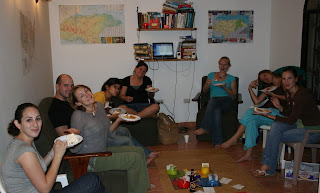
Ahh, one of few truly American holidays. We celebrated it with “gusto” in Honduras last Friday and continued celebrating throughout the weekend. Luke and I offered to host the Paradise (the state we live in is called Paradise) Thanksgiving at our house on Friday. Almost everyone from our department/state made it and a friend of Luke and I’s from a town south of Tegus. We had 9 people total for the main meal on Friday and everyone brought something to share. We had: a 20 lb turkey, mashed potatoes and real gravy from the pan drippings, green bean casserole (I actually had to deep fry onions for the French’s onions), stuffed squash, candied yams, salad (with greens from our garden!), homemade rolls (thanks for the recipe grandma Bauer – they were a hit!), creamed corn, chili con queso soup with fried tortillas (apparently a Texas tradition), cranberry sauce, homemade pumpkin and apple pie (thanks grandma for the crust recipe) and vanilla ice cream. We were definitely in the “turkey coma” starting Friday afternoon until the leftovers finally got eaten Saturday evening! Saturday morning people came back over for my famous homemade Monkey bread and hung out for lunch. A few Paraiso volunteers that had gone to another Tgiving celebration were passing back through Danlí on their way home and stopped by for a beer but ended up staying overnight Saturday and helping us finish up leftovers. People kept stopping in and out, which made it feel like a real Thanksgiving. The last of the guests left yesterday (Sunday) afternoon.

Mass chaos in the kitchen while we got all the food ready!

The pretty pies!

Yummy!
Sitting down to eat
Breaking out the leftovers and board games
Luke overdid it! (see bottom of pic where he´s laying down)
Saturday am: Everyone came back for breakfast
Sat. night: Tara and & I break out the leftovers once again!
Stuffing ourselves for the last time Sat. night

November 12, 2007

In memory...

Moose (Moosey)
December 20, 2004 - November 7, 2007
You were loved by many! We´ll miss you!